
This video speaks volumes about the excitement of stalking the elusive morel. Make sure your audio is turned up
I dont know who M. Chacall might be, but if I were in his shoes in that verdant bed of lurking "morilles" I'd be cackling away too . One senses a certain "joie" in "la chasse" that equals if not surpasses that of the actual harvest.
Sunday, May 30, 2010

Friday, May 28, 2010
Fungal fantasies May fullfillment

After a long hard winter, my annual Spring time trek up to limestone country was not unsuccessful. After the false promises of the escaped specie (see last post) I had some trepidation regarding the annual morel fruitings. About two weeks ago I was delighted to come across several excellent examples of the noble fungus. I didn't find many but those I did were perfect. Sometimes quality trumps quantity. My yield after a full day in the woods? Only three, but they were all the better for their scarcity. And we enjoyed them with white wine butter sauce on our free range chicken breasts. Each bite was a symphony--although one by Webern, not Mahler-- or maybe Feldman is a better analogy. But their authenticity was beyond question--the real McCoy indeed.
I wonder if morels were ubiquitous we'd love them as much. I hear that in the mid West they harvest them by the bushel and then do outrageous, grievous harm to them in the kitchen; breaded and deep fried!!
I have, in some years, found more than a handful--maybe 20-30--but I can't say we enjoyed them any more for their abundance. On the whole, less is more.
And here come the compositional analogue....but, no, it doesn't need to be said, does it?
Thursday, May 13, 2010
Semi-Authentic ?


Walking n East Rock Park the other day, keeping my eyes loosely peeled for morels --they never grow around here, where the soil is very acidic, but you have to keep alert as you never know--I stumbled across a large fruiting of wine red mushrooms in a patch of wood chips under a tall tulip tree. It took me a few minutes to scan through my fungus memory bank, and then I remembered--Stropharia rugosoannulata the so called "King Stropharia"This is an escaped species, believed to be native to Europe but not here. They are widelty cultivated in Europe and maybe here but Ive never seen them for sale
They sprout in the Spring and love woodchips and other garden mulch. Edible and not bad, but not one of the best. Yet they are impressive with their dark wine color and clustered myriads. I consider them to be "semi-authentic." And I know I could make a musical allusion here but I won't-- there's just too many examples of the semi authentic.
But to return to the unalloyed authentic, Louis Andriessen's monumental DE STAAT was resurrected last Monday at Zankel Hall under the guiding hand of John Adams (who also graced us with his own "Son of Chamber Symphony" and Stravinsky's "Concerto for Piano and Winds" -Jeremy Denk was the pianist. It was an amazing concert. I was spell bound, entranced, completely sucked into the glorious brass and woodwind sonorities of Louie's masterpiece. For me, de Staat towers over most music in the latter part of the last century. Its a kind of music that you could say was "invented" as much as it was composed.The enthusiasm of the young musicians of the Carnegie Hall "Academy" (ACJW) was palpable; this is young music and it has finally found its audience and its musicians
Louis is one of the authentic originals of our time.Three cheers to Maestro Adams for his advocacy and skillful rendering of a very subtle piece actually. And please note in the picture of Andriessen above his wielding of a pencil.
Monday, May 3, 2010
Authenticity II-Mondrian's Brush


Last week the iconic Polish composer Penderecki came to Yale and conducted an orchestra concert of his own works, both old and new."Threnody for the Victims of Hiroshima for 52 Strings" held me spell bound; I was astonished at the originality of this 50 year old example of "Sonorism," a style that Penderecki literally invented. The other pieces were of more recent vintage and easily fell into the catch all category of Post Modernism. I suppose Threnody must be considered a perfect example of modernism; but wait! --there's more to it than that; its a genuinely heartfelt work of music emanating from within. It's authentic without question.
When you hear it, or just look at the score with all its graphic notation devices and strange symbols, you know its Penderecki. Sure, there have been scads of similar pieces using all those "extended" techniques pumped out by other composers anxious to hop on the bandwagon, but there is something about this piece--it has his touch, it has been painted with his brush.
Morton Feldman tells the story of Mondrian’s brush: Someone suggested to the Dutch artist that since his color fields were solid blocks of pure color, who not use spray paint to save time and energy? So Mondrian did, but the results were unsatisfactory; the paintings weren’t Mondrians. What was missing was the brush. Likewise, Feldman used a pencil for composition and never other means; his pencil is like Mondrian's brush.
Of course the analogue is that much of our digital technology mimics “hand” created scores, so in a way we are using spray paint!
Our anxiety is more abstract, less to do with the mechanics or craft, more to do with one’s identity. It’s so easy now to be an artist, a composer, but the paradox is that it’s actually harder.
We are still at the mercy of technology, but we suffer the illusion that everything is now possible-—we believe it but still we dream of that infinite realm of possibilities just waiting around the corner.
Feldman wrote: “One never has an identity, as an artist, but in a vague way remembers oneself in that role.”
So, one must be immersed in one’s own history to know one’s true identity—it can never be taken for granted. Maybe the word “authenticity” is the key to all this.
One ought to seek the “authentic” in one’s art and, in seeking it, remembers one’s identity.
That’s why Memory in art is so important-—the two are almost synonymous.
Monday, April 19, 2010
Authenticity
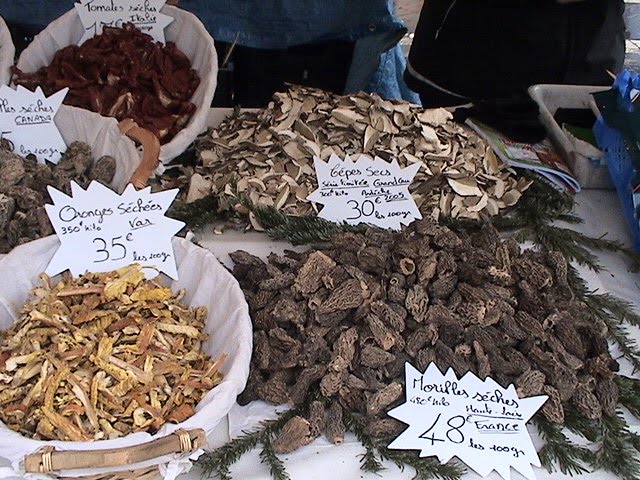
Recently, my lovely wife, Veronica, announced her menu for an upcoming dinner party; the main course would be a butterflied leg of lamb stuffed with WILD MUSHROOMS.As the event will take place in mid May I assumed that the mushrooms would be morels foraged by me. I warned her that my fungal forays sometimes failed to produce much. "Oh, I wasn't planning on your gritty mushrooms; I'll get them at Nicas" (our local "gourmet" market).
"If it's actual wild mushroom you want, you wont find them there" I said. All those so called "wild" ones are cultivated, although occasionally there might be a pile of soggy old chanterelles flown in from Asia or South Africa and priced beyond any reasoned buyer's purse.The shitakes, cremini, porto bellos, oysters, are all frequently mislabeled "wild"--in restaurants as well as stores.
In other words, they are unauthentic.
In France and Italy, in the "off" season you will often find real wild mushrooms that have been dried and these can be quite good if prepared properly.In some ways they are bet er than fresh as the flavors tend to be more concentrated. In the picture above, taken in January at a market in Nice, France, you can see "cepes" (boletes or porcini), "morilles" (morels) and "oronges" (Caesar's mushrooms, similar to the coccoras I found in California last November)
I've never tried "oronges sechees" but I can vouch for dried morels--they are strongly perfumed and keep their form after being re-hydrated and cooked; and of course, dried porcini are wonderful in risotti and pasta--you don't need many to impart a real flavor and aroma of the earth.
And there's something about AUTHENTICITY in music that this wild mushroom issue illuminates.It boggles the mind to come across composers now a days who still slavishly follow the "Indeterminate" Cagean point of view (I don't'call it a style or aesthetic) and compose with conceptual ideas which may translate into some kind of music, although usually not.A case in point recently came to my attention; this music (and I shan't mention the culprit's name) seemed to have all the right identifiers to be deemed part of the 70's avant garde which dealt in static, repetitive, minimalistic and chance procedures, as well as arbitrary mathematical schemes that generated notes and rhythms. He obviously owed a lot to Cage and Feldman if not Reich and Riley.
This was sonic randomness, wherein the composer could stand back and feign indifference to the actual sound world he had unleashed, as if it had nothing to do with him--the Cagean idea of eliminating personality from composition.
This "music" came not from within but from outside, delineating ideas that he had absorbed almost as text book examples of what experimental music of that era was like. It sported "cleverness" but lacked authenticity. Period.
This music struck me as hollow, not from a true source of artistic "realness." But then again, searching for the Real is often a thankless task. Sometimes to find the Authentic you have to forage in the woods.
Saturday, March 20, 2010
Rites of Spring (soon!)

I noticed snow drops and crocus emergent in my neighbors yard this afternoon, and I thought that in only two months I will be out in the woods snuzzleing around in the leaf litter searching for the elusive MOREL!
But thats still a long time off--mustn't get too excited.
there's something wonderful about seasonal food--produce of short duration that you long for throughout the year and can only get for a few weeks maybe. Strawberries for example (no, not the fat ones from California that come in mid winter--worthless! I mean the local small guys that fruit in May and June only for a few weeks. And asparagus- the skinny green ones that always grace out Eastertide plates,
how about shad roe or the actual fish?
Can you imagine a dish of poached shad with asparagus and morels??
It's not that we haven't enjoyed some recent mushroom culinary adventures. Veronica brought back from a trip to Trieste, a jar of wild mushrooms from Slovenia, preserved in some kind of pickle. The label in Slovenian reads:
GOZDNI JURCKI B KISU
From what I can make out from a Croatian dictionary (Slovenian is close to Serbo-Croatian) it simply means "Forest Mushrooms in Vinegar." As to the species, it looks like there were a few boletes in the mix, but the others I couldn't identify. They are quite tasty eaten as is, but I thought they might enhance a pizza rather well, and they did, although the vinegar does stand out as the forward flavor. In Italy you can get mushroom "under oil" ("sott'olio") without the acidic "aceto" and these, while expensive, are quite good.
For most wild mushrooms, drying is the best preservation, but the oil immersion works well too; freezing is not good, usually resulting in a sodden mush.
In San Francisco, back in the day, I used to forage for "slippery jacks" out in the far reaches of the city hard by the old Sutro Baths and Seal Rocks--Lincoln Park I think it was called. There were several species of Suillus, a relative of the bolete. to be found there. These slimy topped mushrooms were quite tasty once you pealed off the slippery cap. The local Russians (there was an old colony of Russians out there in the outer Richmond) could often be seen foraging; I asked on older lady how they were prepared in traditional Russian cookery and she directed me to a delicatessen nearby where i found slippery jacks pickled and put up in jars. Naturally I purchased a large jar but I found them to be, well, a bit slimy--but I ate them all anyhow, although no one else did.
BTW, the pizza I made last night with the pickled Slovenes, was quite tasty although it looked to be a chaotic disaster--I had a bit of trouble getting the oil drenched dough into shape and into the oven in one piece. My pizza dough making chops are a bit rusty to say he least.
Tuesday, February 23, 2010
Shutter Island: Addendum
If anyone has seen the movie, I'd be curious to hear your opinion, especially as to the efficacy of the soundtrack
Subscribe to:
Posts (Atom)