Monday, April 19, 2010

Authenticity


Recently, my lovely wife, Veronica, announced her menu for an upcoming dinner party; the main course would be a butterflied leg of lamb stuffed with WILD MUSHROOMS.As the event will take place in mid May I assumed that the mushrooms would be morels foraged by me. I warned her that my fungal forays sometimes failed to produce much. "Oh, I wasn't planning on your gritty mushrooms; I'll get them at Nicas" (our local "gourmet" market).
"If it's actual wild mushroom you want, you wont find them there" I said. All those so called "wild" ones are cultivated, although occasionally there might be a pile of soggy old chanterelles flown in from Asia or South Africa and priced beyond any reasoned buyer's purse.The shitakes, cremini, porto bellos, oysters, are all frequently mislabeled "wild"--in restaurants as well as stores.
In other words, they are unauthentic.
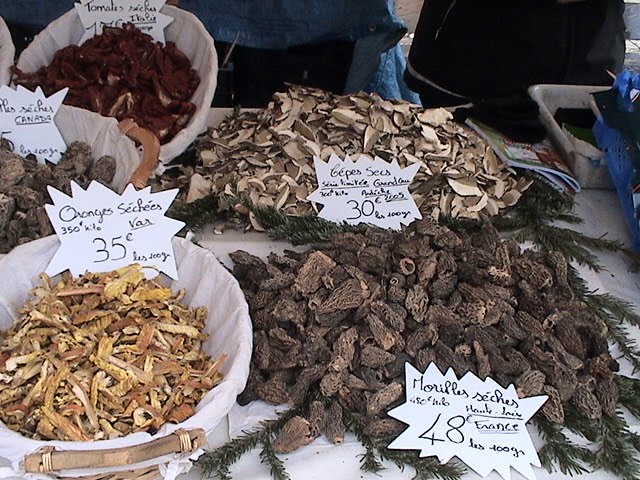
In France and Italy, in the "off" season you will often find real wild mushrooms that have been dried and these can be quite good if prepared properly.In some ways they are bet er than fresh as the flavors tend to be more concentrated. In the picture above, taken in January at a market in Nice, France, you can see "cepes" (boletes or porcini), "morilles" (morels) and "oronges" (Caesar's mushrooms, similar to the coccoras I found in California last November)
I've never tried "oronges sechees" but I can vouch for dried morels--they are strongly perfumed and keep their form after being re-hydrated and cooked; and of course, dried porcini are wonderful in risotti and pasta--you don't need many to impart a real flavor and aroma of the earth.

And there's something about AUTHENTICITY in music that this wild mushroom issue illuminates.It boggles the mind to come across composers now a days who still slavishly follow the "Indeterminate" Cagean point of view (I don't'call it a style or aesthetic) and compose with conceptual ideas which may translate into some kind of music, although usually not.A case in point recently came to my attention; this music (and I shan't mention the culprit's name) seemed to have all the right identifiers to be deemed part of the 70's avant garde which dealt in static, repetitive, minimalistic and chance procedures, as well as arbitrary mathematical schemes that generated notes and rhythms. He obviously owed a lot to Cage and Feldman if not Reich and Riley.
This was sonic randomness, wherein the composer could stand back and feign indifference to the actual sound world he had unleashed, as if it had nothing to do with him--the Cagean idea of eliminating personality from composition.
This "music" came not from within but from outside, delineating ideas that he had absorbed almost as text book examples of what experimental music of that era was like. It sported "cleverness" but lacked authenticity. Period.
This music struck me as hollow, not from a true source of artistic "realness." But then again, searching for the Real is often a thankless task. Sometimes to find the Authentic you have to forage in the woods.

Saturday, March 20, 2010

Rites of Spring (soon!)


I noticed snow drops and crocus emergent in my neighbors yard this afternoon, and I thought that in only two months I will be out in the woods snuzzleing around in the leaf litter searching for the elusive MOREL!
But thats still a long time off--mustn't get too excited.
there's something wonderful about seasonal food--produce of short duration that you long for throughout the year and can only get for a few weeks maybe. Strawberries for example (no, not the fat ones from California that come in mid winter--worthless! I mean the local small guys that fruit in May and June only for a few weeks. And asparagus- the skinny green ones that always grace out Eastertide plates,
how about shad roe or the actual fish?
Can you imagine a dish of poached shad with asparagus and morels??

It's not that we haven't enjoyed some recent mushroom culinary adventures. Veronica brought back from a trip to Trieste, a jar of wild mushrooms from Slovenia, preserved in some kind of pickle. The label in Slovenian reads:

GOZDNI JURCKI B KISU

From what I can make out from a Croatian dictionary (Slovenian is close to Serbo-Croatian) it simply means "Forest Mushrooms in Vinegar." As to the species, it looks like there were a few boletes in the mix, but the others I couldn't identify. They are quite tasty eaten as is, but I thought they might enhance a pizza rather well, and they did, although the vinegar does stand out as the forward flavor. In Italy you can get mushroom "under oil" ("sott'olio") without the acidic "aceto" and these, while expensive, are quite good.


For most wild mushrooms, drying is the best preservation, but the oil immersion works well too; freezing is not good, usually resulting in a sodden mush.
In San Francisco, back in the day, I used to forage for "slippery jacks" out in the far reaches of the city hard by the old Sutro Baths and Seal Rocks--Lincoln Park I think it was called. There were several species of Suillus, a relative of the bolete. to be found there. These slimy topped mushrooms were quite tasty once you pealed off the slippery cap. The local Russians (there was an old colony of Russians out there in the outer Richmond) could often be seen foraging; I asked on older lady how they were prepared in traditional Russian cookery and she directed me to a delicatessen nearby where i found slippery jacks pickled and put up in jars. Naturally I purchased a large jar but I found them to be, well, a bit slimy--but I ate them all anyhow, although no one else did.
BTW, the pizza I made last night with the pickled Slovenes, was quite tasty although it looked to be a chaotic disaster--I had a bit of trouble getting the oil drenched dough into shape and into the oven in one piece. My pizza dough making chops are a bit rusty to say he least.

Tuesday, February 23, 2010

Shutter Island: Addendum

If anyone has seen the movie, I'd be curious to hear your opinion, especially as to the efficacy of the soundtrack

Monday, February 22, 2010

SHUDDER ISLAND


Sitting in the movie theater last Friday, nervously waiting for the familiar fog horn blasts which announce the beginning of my old chestnut "Fog Tropes" I had some apprehension as I knew my music would start the actual movie, Shutter Island starring Leonardo di Caprio, but I had no idea what would appear on the screen.
Well, Leo and his US Marshal pal, Mark Ruffalo, are on a small ferry boat in choppy seas heading out to their island destination, and the music syncs up nicely with the image (Leo is leaning over the bow--a not so subtle allusion to Titanic?), and suddenly cuts to him violently vomiting in the head--Fog Tropes continues with the French horns and trombones weighing in.

So my musical debut in a major Hollywood film, seen and heard by millions, accompanies one of the biggest stars tossing his cookies. Great.

But it does get better; there's a couple of more cues where the mood is set quite well by the music--not just Fog Tropes but "Prelude: The Bay" from "Alcatraz"
If you see this quite unique film (critical opinion is about evenly split--you either love it or hate it) you'll also hear music by Penderecki, Ligeti, Cage, Scelsi and a host of others. The most ominous affect is garnered from Penderecki's Third Symphony "Passacaglia" which barks out in a sort of anunciatory way at least four times in the film's course.
All this music was assembled by Scorsese confidant Robbie Robinson, formerly of "The Band."I have to say, it works for the most part--The ultimate re-mix approach to film scoring.

They say the film was shot in Massachusetts, but the outdoor scenes on the rugged island with its pine forest and verdant cliffs remind me more of Maine; I imagined that a good bounty of chanterelles might be lurking in those woods (Maine in the early Fall is great for mushrooms).Too bad Mark and Leo didnt have time to do some foraging (or maybe they did?) Perhaps when the DVD comes out with its "Behind the Scenes" doc we'll see the cast out in their spare time prowling around those cliffs and mossy copses in pursuit of the golden beauties--after all, Scorsese and diCaprio with their Italian heritages ought to be fanciers of funghi selvaggi.

Saturday, February 6, 2010

Saga


No snow for us today in New England (although they are getting inundated further south in DC) but it's very cold and windy. Good weather for staying home, but I ventured out into the frigid world taking my usual route up to Whitney Peak. Too cold a day for Schubert on the iPod. Sibelius somehow seemed more appropriate.

En Saga--one of Sibbe's lesser known tone poems but one of my favorites. its all about inexorable forward movement and retreat-or more a kind of stasis or slow motion. I think. But oh how wonderful it is to have music like that in one's ears just when one needs it! It complements the icy weather to a T and kept me moving. It got me thinking about the saturation of our society now, sonic saturation that is. Supposedly a hallmark of Post Modernism. It's so easy to have any music where or whenever!! I think the twenty-somethings just take this for granted and why not?) But I can remember back in the 80s when portable music became feasible how miraculous it could be. I remember my first visit to Venice when I walked through San Marco with the antiphonal sounds of Gabrielli on my headphone, and in the"Frari" Basilica I listened to Monteverdi's Magnificat, and out on the lagoon on the vaporetto, the slow movement of Mahler's 5th just as it was in Visconti's marvelous film of "Death in Venice."

And today I thought of another Thomas Mann book, one I've been reading in fact-- The Magic Mountain. Hans Castorp, the protagonist, becomes enamoured and possessive of the new Gramophone the Kurhaus has acquired (this is pre WW I remember). It's like a miracle to him; he stays up late into the night listening to his favorite records which he treats like sacred objects; he can't get enough of it. Mann's description of the amazement and wonder this musical machine inspired in its early days is one of my favorite parts of the lengthy novel. While he doesn't directly talk about it, the idea of the commodification of music is the underlying theme.
For me, listening to music while out walking or driving is still special in that I choose to do it only when I want to, which isn't all that often. But I think for many young people its part of life-- the soundtracks of their lives are habitually running.

Monday, February 1, 2010

Postmodern Mushrooms


I am teaching a course called "Post Modernism in Music of the last 30 years" (or something to that effect)
When I mention this to people they often ask me flat out,
"What is it?"
"Well, I don't rightly know for sure," is what I usually mumble.
"I think the idea of the class is to find out."
PM, whatever it is, seems to be a necessity, a way of getting out from under the suffocating blanket of Modernism, or at least the "high" kind with all its ideological trappings and high falutin language.Modernism in music seems to me to have been just plain wrong, a seriously wrong direction.
BUT, there are some excellent composers in the early experimental days of Modernism--early Schoenberg, Webern Varese, Cowell, Ives, Ruggles et al. With them the idea was to "sound "modern" at any cost, structure and formality being relatively less important. Of course, with later Modernism, structure, process and form became all important.

Just as Modernism is not a "style" but more of an aesthetic inclination, a cultural context, so it is with PM, which will, I think, be remembered as a general cultural trend, a "correction," if you will.

The more obtuse and serious purveyors of "theory" see PM in a much broader way--it is a "condition." And we are all living in it, so in a way all music, all art for that matter, being practiced now is, by default, PM

So, mushrooms themselves cannot be PM, but one's attitude towards them, use of them, general relationship to them, could be PM where the grand narrative of fungi, the scientific taxonmomic ordering of species is no longer relevant.But in this context,let the consumer beware!

But what would John Cage think about that, and it reminds me that no one seems to know if Cage himself was a Modernist or Post Modernist. I think He was very PM, but his music (whatever that is) is not--it is in fact quite Modernist.

But why, you may ask, is the mushroom illustrated above "postmodern? It might be because it's called, in the vernacular, "Old Man of the Woods," and I can relate to that. BTW, Strobilomyces floccopus is edible, and I have tried it, but I don't recommend it; its rather insipid as I recall.

Thursday, January 28, 2010

Trompettes des Morts


While I am shoveling out the latest white precipitation, my West Coast fungal friends are gleefully harvesting oodles of "black chanterelles or "trompettes des morts" as they are inexplicably called --(ok, they are black/ gray and have a certain haunted look.) They are also called Horns of Plenty derived from the latin name Craterellus Cornucopioides. To add insult to injury they send me a picture of the latest haul. Disgusting!

We East coast mushroom fanciers have to live vicariously in the frosty months. In California these dusky guys can be found in large quantities under live oak and laurel and since they dry well, can be stored for later consumption. We do do get them here, in August, and last year I collected quite a few and dried them. To reconstitute all you need do is soak then for 5-10 minutes and they are ready for the saute pan, or the risotto pot, or the pasta sauce--whatever!
So my California friends needn't feel guilty about the picture--I have my own stash of trompettes sechees.

But wait! Merde!! A search into the larder reveals an empty jar--there's none left! All I can find in that dark cupboard is a bunch of dried wood ears (auricularia sp.) or tree fungus as the Chinese call them, and these not foraged but purchased in the local Asian food market. I put a handful to soak and later that night I find them ballooned up to three times their original size--quite a show. But they are tough, and practically devoid of flavor;the Chinese consider them a "texture" food. They are crunchy, good in soups and reportedly full of healthful things.

Indeed, there are all kinds of amazing claims made about the health benefits of fungi, and some of them may be true.Those made about reishi (ganoderms sp.) which is a "conk" growing on dead pines or firs in New England are particularly interesting and the subject of serious research.